
Moment of Inertia of Flywheel
Procedure
Apparatus:
Fly wheel, weight hanger, slotted weights, stop watch, metre scale.
Procedure for doing Simulator
Step 1: Select the Environment
- Click the Choose Environment dropdown menu.
- Select the desired environment (e.g., Earth, g = 9.8 m/s²).
Note: Use Earth for the initial experiment. Later, repeat the experiment with other environments (such as the Moon or Mars) to observe the effect of gravity.
Step 2: Set the Flywheel Parameters
Use the sliders under the VARIABLES section to configure the experiment.
- Mass of Flywheel (M)
- Diameter of Flywheel (D)
- Mass of Hanging Weight (m)
- Diameter of Axle (d)
- Number of Wounds of Chord (N₁)
Note: Keep the flywheel parameters constant during the first trial. Change only one parameter at a time in subsequent trials.
Step 3: Start the Experiment
- Click RELEASE FLY WHEEL.
- Observe the following:
- The hanging weight descends and rotates the flywheel.
- The cord slips off the axle after unwinding.
- The flywheel continues rotating due to inertia and gradually comes to rest because of friction.
Step 4: Record the Observations
After the flywheel stops:
- Record the Number of Revolutions (N₂) displayed near the axle.
- Record the Time (t) shown on the digital stopwatch.
Step 5: Repeat the Experiment
- Change one or more input parameters.
- Repeat the experiment.
- Record the observations for each trial.
- Compare the results for different values of mass, dimensions, or gravitational environment.
Procedure for doing Real Lab
- The length of the cord is carefully adjusted, so that when the weight-hanger just touches the ground,the loop slips off the peg.
- A suitable weight is placed in the weight hanger
- A chalk mark is made on the rim so that it is against the pointer when the weight hanger just touches the ground.
- The other end of the cord is loosely looped around the peg keeping the weight hanger just touching the ground.
- The flywheel is given a suitable number (n) of rotation so that the cord is wound round the axle without overlapping.
- The height (h) of the weight hanger from the ground is measured.
- The flywheel is released.
- The weight hanger descends and the flywheel rotates.
- The cord slips off from the peg when the weight hanger just touches the ground.By this time the flywheel would have made n rotations.
- A stop clock is started just when the weight hanger touches the ground.
- The time taken by the flywheel to come to a stop is determined as t seconds.
- The number of rotations (N) made by the flywheel during this interval is counted.
- The experiment is repeated by changing the value of n and m.
- From these values the moment of inertia of the flywheel is calculated using equation
Observations
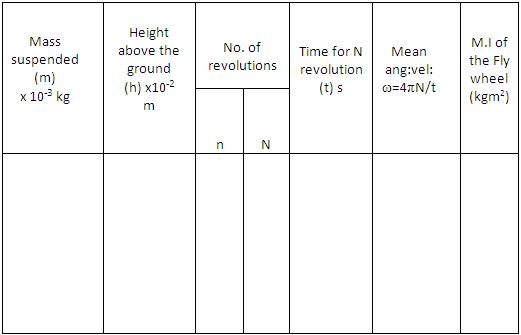
Mean value of moment of inertia,I =.........kgm2
Result
Moment of inertia of the fly wheel =.........kgm2